
Filter by jurisdictions
- ASEAN 1
- Asia Pacific 26
- Australia 5
- Brazil 2
- Calif 1
- California 8
- Canada 1
- China 1
- Denmark 1
- Draft proposal 32
- EU 11
- Enforcement 1
- Europe 15
- Final rules 37
- France 1
- Illinois 1
- India 1
- Indonesia 1
- Japan 2
- Latin America 4
- Minnesota 2
- New Jersey 2
- New Mexico 1
- New York 3
- New Zealand 1
- North America 1
- Oceania 6
- Peru 2
- Philippines 5
- Singapore 1
- South Korea 1
- Southeast Asia 10
- Taiwan 4
- UK 3
- US federal 3
- US states 16
- Ukraine 1
- United States 20
- Vietnam 5
- Virginia 1
- Washington D.C. 1
- Washington state 1

UK consults on streamlined registration requirements for chemicals already on the GB market
The UK is consulting on draft legislation for its Alternative Transitional Registration model (ATRm), which would reduce information requirements for chemicals transitioning from EU to UK REACH. Comments are due by 10 November 2026, with registration deadlines beginning 27 October 2029.

ECHA seeks evidence on MDA and MOCA in articles ahead of possible restriction
ECHA is seeking evidence by 18 November 2026 on unreacted MDA (CAS 101-77-9) and MOCA (CAS 101-14-4) above 0.1% w/w in articles, including polyurethane, epoxy and coated products. The 7 October 2026 call could lead to an EU restriction proposal if ECHA identifies risks that are not adequately controlled.

Canada proposes to align CMR criteria under CEPA with GHS
Canada is consulting on GHS-based criteria for identifying carcinogenic, mutagenic and reproductive toxicants (CMRs) under CEPA. The criteria could help determine which toxic substances are prioritized for prohibition. Comments are due 2 December 2026, with proposed regulations expected in 2027.

California becomes the second US state to ban bisphenols in paper receipts
California will prohibit intentionally added bisphenol A (BPA; CAS 80-05-7) in paper receipts from 1 January 2028 and expand the ban to bisphenols, including bisphenol S (BPS; CAS 80-09-1), from 1 January 2029 under AB 1604.

California requires detailed ingredient disclosure for children’s diapers amid industry concerns over Confidential Business Information
California AB 1901 will require children’s diaper manufacturers to disclose intentionally added ingredients, CAS numbers and ingredient functions, amid industry concerns over confidential business information. Requirements begin 1 January 2029, with a 1 July 2029 packaging deadline for diapers sold in California.

California tightens court review of Proposition 65 settlements
California AB 2577 tightens court review of private Proposition 65 settlements, requiring a finding that settlements are in the public interest and provide a public benefit. The private enforcer bears the evidentiary burden, while new rules allow attorneys’ fee disputes to be resolved separately.

California eases GBL reporting and permitting for semiconductor industry
California’s SB 1306 eases permitting and reporting requirements for certain mixtures containing gamma-butyrolactone (GBL; CAS 96-48-0), a solvent used in semiconductor manufacturing and research. The exemption covers qualifying mixtures containing 70% or less GBL by weight or volume.

EU weighs new restrictions on Michler’s ketone and Michler’s base in imported products
ECHA is examining whether further REACH restrictions are needed for 4,4'-bis(dimethylamino)-4''-(methylamino)trityl alcohol (CAS 561-41-1), Michler’s ketone and Michler’s base in imported articles. The chemicals may occur through dyes, inks, pigments, coatings and adhesives used in packaging, plastics, electronics, paper, textiles and leather, raising new supply-chain questions for companies selling products into the EU.
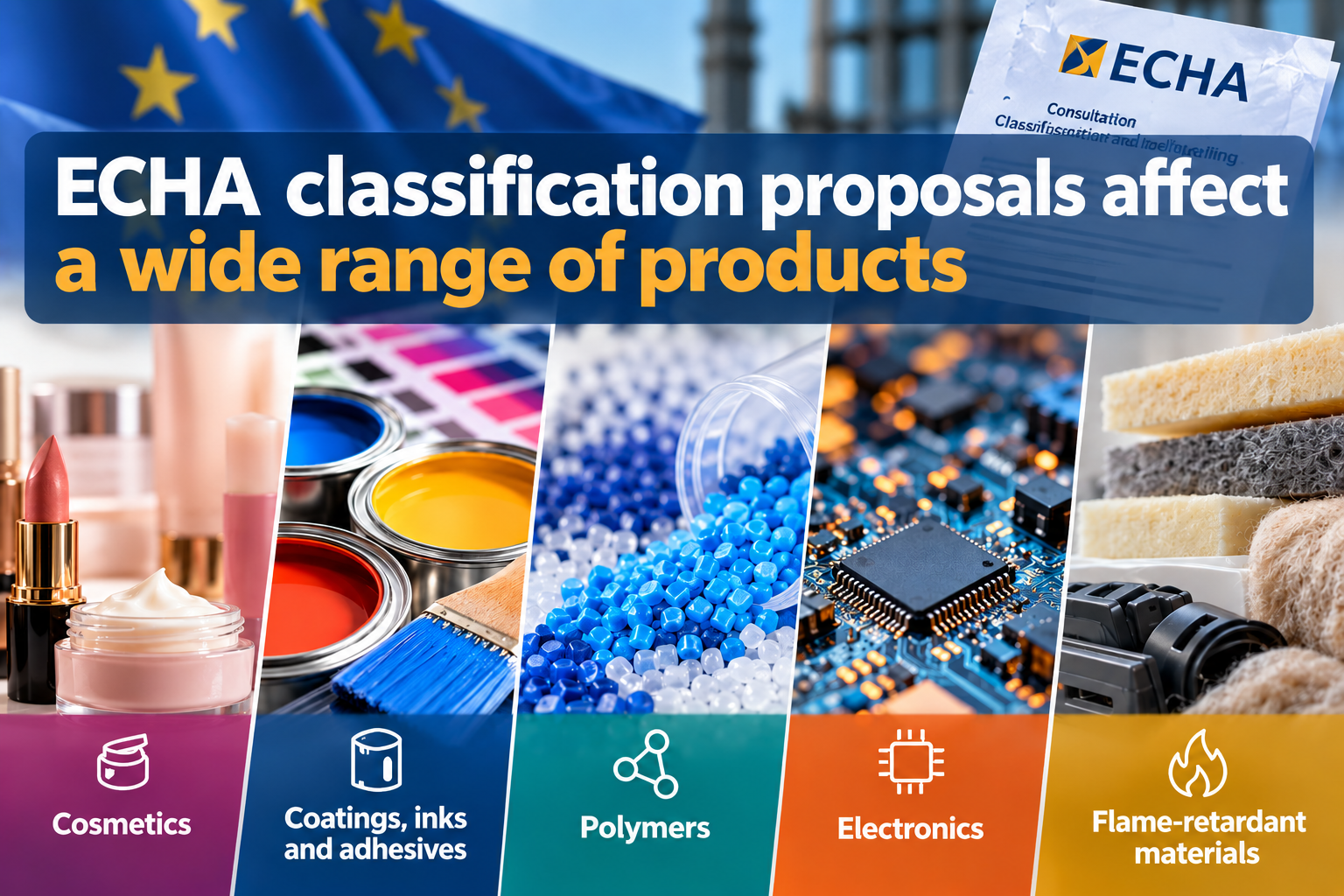
ECHA classification proposals put cosmetics, coatings, polymers, and electronics in focus
ECHA is consulting on new classifications for ethyl 4-(dimethylamino)benzoate, 2-ethylhexyl 4-(dimethylamino)benzoate and 3-methylbutyl 4-(dimethylamino)benzoate, as well as chlorendic anhydride and eight phthalic anhydrides. The proposals cover reproductive toxicity, suspected carcinogenicity, and respiratory sensitization and could affect cosmetics, electronics, coatings, inks, adhesives, polymers, and flame-retardant materials.
Fifth Circuit overturns EPA methylene chloride rule, reopening fight over chemical controls
The Fifth Circuit has overturned the EPA’s 2024 methylene chloride rule, removing restrictions on numerous products and industrial uses. The ruling offers industry immediate regulatory relief but raises new uncertainty about worker protections and the future of chemical regulation under TSCA.

Beyond the Scrapyard: How Europe’s New Vehicle Circularity Rules Will Reshape Automotive Business
Compliance with Europe’s new vehicle circularity rules will depend on decisions made years before the deadlines arrive. This analysis examines how manufacturers, suppliers and recyclers must rethink material sourcing, product design, supplier contracts, regulatory data and investment planning to prepare for the new system.

Taiwan aligns GHS requirements with Revision 8
Taiwan has aligned its hazardous chemical requirements with GHS Revision 8, introducing immediate changes to SDS thresholds, disclosure and enforcement while giving businesses until 1 January 2029 to complete major classification, labeling and SDS updates.

Vietnam’s Regulatory Reset Raises Near-Term Risks for Global Businesses
Vietnam is undergoing a sweeping regulatory reset. Government restructuring, a new chemicals framework, risk-based product controls, digital labeling and expanding producer responsibility are changing how companies manufacture, import and sell products in the country. For businesses, the biggest challenge may not be any single rule—but the speed at which the entire compliance landscape is changing.

EU’s New End-of-Life Vehicles Regulation Extends Circularity Rules From Vehicle Design to Recycling
The EU’s new End-of-Life Vehicles Regulation (Regulation (EU) 2026/1738) moves automotive circularity beyond the scrapyard and into vehicle design, manufacturing, and supply-chain management. With phased requirements beginning in 2028, companies must prepare for recycled-content targets, digital vehicle passports, expanded producer responsibility, and tighter export controls.

Taiwan proposes controls on six chemicals, targeting food-safety risks, bisphenols, and industrial misuse
Taiwan is proposing new controls on six chemicals, including bisphenol B, bisphenol F, C.I. Pigment Red 3, Para Red, MMMP and GBL, with new approval, reporting, recordkeeping and labelling requirements and compliance deadlines beginning in 2027.

Australia’s compliance deadline hits cosmetics, green tea extracts, and marine paints
Australia’s 1 October 2026 deadline will require new label statements for cosmetics containing BPA glycidyl dimethacrylate or BPA glycidyl diacrylate, liver warnings for high-dose green tea extracts and a lower lead limit for anti-fouling paints.

California targets online sales, QR codes, retailer duties, and short-form labeling in a broad Proposition 65 warning overhaul
California is considering broad Proposition 65 warning changes affecting online sales, QR codes, retailer duties, off-road equipment parts and short-form labels. Companies should review the proposals, monitor OEHHA’s position on chemical disclosures and consider commenting before the agency advances formal rulemaking.

Brazil adopts long-awaited RoHS framework for electrical and electronic equipment (EEE)
Brazil has adopted its long-awaited RoHS framework, restricting ten substances (PBB, PBDE, mercury, cadmium, hexavalent chromium, lead, DEHP, BBP, DBP, and DIBP) in electrical and electronic equipment while introducing registration, self-declarations, and Portuguese-language documentation.

Australia tightens controls on retinal as cosmetic safety concerns grow
Australia now requires pre-market assessment for retinal used in cosmetics and other consumer products after AICIS identified developmental toxicity concerns. A related evaluation also flagged potential risks from cumulative exposure to retinol and several retinol esters in skincare and personal-care products.

Federal court pauses California “Truth in Recycling” compliance deadline
A federal court has paused enforcement of key provisions of California’s SB 343, placing the 4 October 2026 compliance deadline for recyclability claims on hold while a constitutional challenge proceeds.