
Filter by jurisdictions
- ASEAN 1
- Asia Pacific 26
- Australia 5
- Brazil 2
- Calif 1
- California 8
- Canada 1
- China 1
- Denmark 1
- Draft proposal 32
- EU 11
- Enforcement 1
- Europe 15
- Final rules 37
- France 1
- Illinois 1
- India 1
- Indonesia 1
- Japan 2
- Latin America 4
- Minnesota 2
- New Jersey 2
- New Mexico 1
- New York 3
- New Zealand 1
- North America 1
- Oceania 6
- Peru 2
- Philippines 5
- Singapore 1
- South Korea 1
- Southeast Asia 10
- Taiwan 4
- UK 3
- US federal 3
- US states 16
- Ukraine 1
- United States 20
- Vietnam 5
- Virginia 1
- Washington D.C. 1
- Washington state 1

UK consults on streamlined registration requirements for chemicals already on the GB market
The UK is consulting on draft legislation for its Alternative Transitional Registration model (ATRm), which would reduce information requirements for chemicals transitioning from EU to UK REACH. Comments are due by 10 November 2026, with registration deadlines beginning 27 October 2029.

ECHA seeks evidence on MDA and MOCA in articles ahead of possible restriction
ECHA is seeking evidence by 18 November 2026 on unreacted MDA (CAS 101-77-9) and MOCA (CAS 101-14-4) above 0.1% w/w in articles, including polyurethane, epoxy and coated products. The 7 October 2026 call could lead to an EU restriction proposal if ECHA identifies risks that are not adequately controlled.
Canada proposes to align CMR criteria under CEPA with GHS
Canada is consulting on GHS-based criteria for identifying carcinogenic, mutagenic and reproductive toxicants (CMRs) under CEPA. The criteria could help determine which toxic substances are prioritized for prohibition. Comments are due 2 December 2026, with proposed regulations expected in 2027.
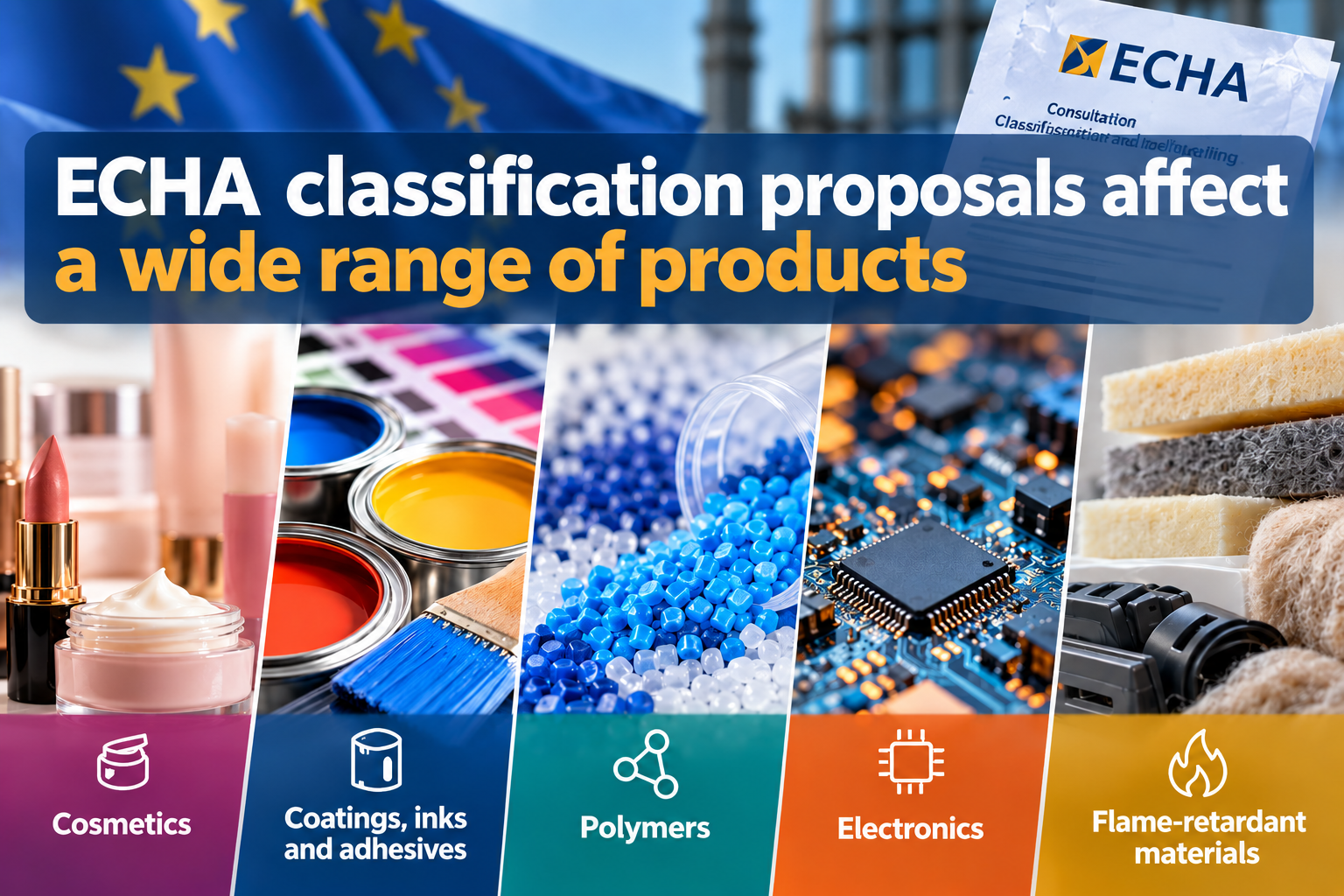
ECHA classification proposals put cosmetics, coatings, polymers, and electronics in focus
ECHA is consulting on new classifications for ethyl 4-(dimethylamino)benzoate, 2-ethylhexyl 4-(dimethylamino)benzoate and 3-methylbutyl 4-(dimethylamino)benzoate, as well as chlorendic anhydride and eight phthalic anhydrides. The proposals cover reproductive toxicity, suspected carcinogenicity, and respiratory sensitization and could affect cosmetics, electronics, coatings, inks, adhesives, polymers, and flame-retardant materials.

Taiwan proposes controls on six chemicals, targeting food-safety risks, bisphenols, and industrial misuse
Taiwan is proposing new controls on six chemicals, including bisphenol B, bisphenol F, C.I. Pigment Red 3, Para Red, MMMP and GBL, with new approval, reporting, recordkeeping and labelling requirements and compliance deadlines beginning in 2027.

California targets online sales, QR codes, retailer duties, and short-form labeling in a broad Proposition 65 warning overhaul
California is considering broad Proposition 65 warning changes affecting online sales, QR codes, retailer duties, off-road equipment parts and short-form labels. Companies should review the proposals, monitor OEHHA’s position on chemical disclosures and consider commenting before the agency advances formal rulemaking.

Philippines introduces bill mandating recycling label
Philippines House Bill No. 9281 would require recycling labels, material disclosures, disposal instructions, and substantiated packaging claims.

EU consults on new harmonized classification for silver chloride, chloroethane and other chemicals
EU harmonized classification proposals for silver chloride, chloroethane, 1-isopropyl-2,2-dimethyltrimethylene diisobutyrate, N’-(1,3-dimethylbutylidene)-3-hydroxy-2-naphthohydrazide and Solvent Yellow 124 could trigger mixture reclassification, labeling changes, SDS updates and broader regulatory scrutiny across consumer and industrial products.

Public comment period is ending for Minnesota’s “unavoidable use” rule for exempting PFAS prohibition
Minnesota advances PFAS exemption rule, detailing CUU waivers, timelines, and key industry questions ahead of the 2032 ban.

Brazil on track to implement RoHS-style restrictions on hazardous substances in electronics
Brazil updates draft proposal to implement RoHS-style EEE rules, adding exemptions, stricter registration, and phased deadlines aligned with EU standards.

EU PFAS ban moves forward as ECHA committees issue key opinions
ECHA advances EU PFAS restriction as RAC adopts its opinion and SEAC agrees draft socio-economic assessment for consultation.

New rat study triggers ECHA to review its previous CLP classification for glyphosate
ECHA launches a consultation, ending on 31 March 2026, on CLP classification of glyphosate after a 2025 rat study reporting tumors challenges RAC’s 2022 finding of no carcinogenicity.

Virginia poised to join states requiring ingredient disclosure for menstrual products
Virginia’s bill — HB998 — that would require menstrual product ingredient disclosure on packaging and online now awaits the governor’s signature. If signed, the law takes effect January 1, 2027.

California Moves to Phase Out Bisphenols in Paper Receipts Under AB 1604
California’s AB 1604 would phase out bisphenols in thermal receipt paper, banning BPA in 2027 and expanding the restriction to all bisphenols by 2028.

ECHA proposes to phase out four substances
ECHA consults on adding four SVHCs to to the Authorization list (UV-326, UV-329, Triphenyl phosphate, 2-(dimethylamino)-2-[(4- methylphenyl)methyl]-1-[4- (morpholin-4- yl)phenyl]butan-1-one), signaling the agency’s intention on phasing out the chemicals.

Japan seeks to restrict 117 PFHxS substances under Chemical Substances Control Law
Japan proposes PFHxS ban under CSCL, covering 117 substances, with restrictions on manufacture, import, and use starting June 2026.

New York’s Beauty Justice Act is given new life
New York advances proposed Beauty Justice Act to restrict toxic chemicals (borates, formaldehyde, orthophthalates, parabens, PFAS, xylanes) in cosmetics.

UK confirms deadline extensions for chemical registration
UK delays REACH registration deadlines to 2029–2031, giving industry more time while maintaining compliance tracking obligations.

FDA Proposes First New Sunscreen Active Ingredient in Decades
FDA proposes adding bemotrizinol to U.S. sunscreens at 6%, compared with 10% limits already used in the EU, Japan and Canada.

Philippines proposes to add new chemicals to its national chemical inventory
Proposed changes to PICCS would add 140 chemicals, easing notification requirements for manufacturers and importers.