
Filter by jurisdictions
- ASEAN 1
- Asia Pacific 26
- Australia 5
- Brazil 2
- Calif 1
- California 8
- Canada 1
- China 1
- Denmark 1
- Draft proposal 32
- EU 11
- Enforcement 1
- Europe 15
- Final rules 37
- France 1
- Illinois 1
- India 1
- Indonesia 1
- Japan 2
- Latin America 4
- Minnesota 2
- New Jersey 2
- New Mexico 1
- New York 3
- New Zealand 1
- North America 1
- Oceania 6
- Peru 2
- Philippines 5
- Singapore 1
- South Korea 1
- Southeast Asia 10
- Taiwan 4
- UK 3
- US federal 3
- US states 16
- Ukraine 1
- United States 20
- Vietnam 5
- Virginia 1
- Washington D.C. 1
- Washington state 1

ECHA seeks evidence on MDA and MOCA in articles ahead of possible restriction
ECHA is seeking evidence by 18 November 2026 on unreacted MDA (CAS 101-77-9) and MOCA (CAS 101-14-4) above 0.1% w/w in articles, including polyurethane, epoxy and coated products. The 7 October 2026 call could lead to an EU restriction proposal if ECHA identifies risks that are not adequately controlled.
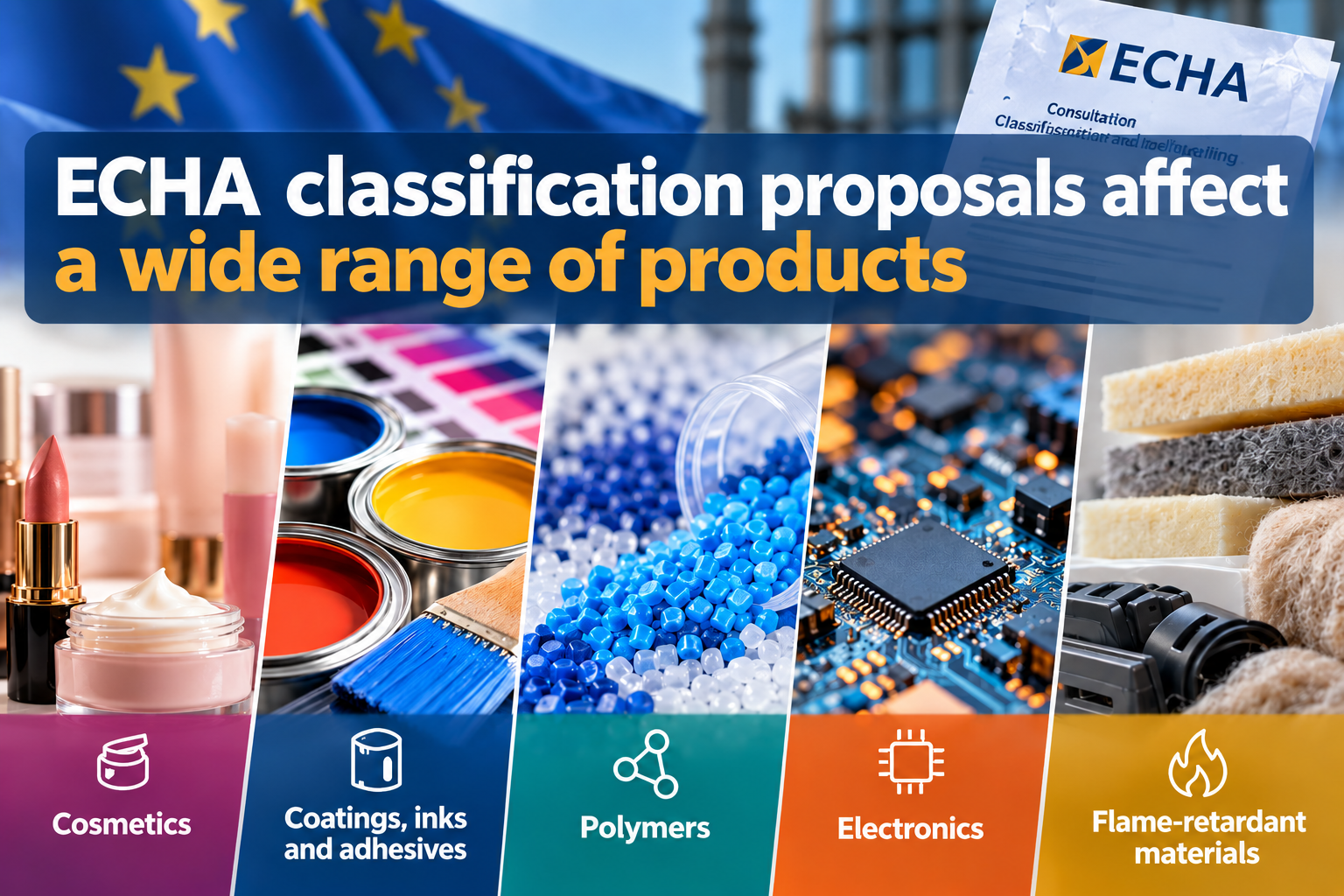
ECHA classification proposals put cosmetics, coatings, polymers, and electronics in focus
ECHA is consulting on new classifications for ethyl 4-(dimethylamino)benzoate, 2-ethylhexyl 4-(dimethylamino)benzoate and 3-methylbutyl 4-(dimethylamino)benzoate, as well as chlorendic anhydride and eight phthalic anhydrides. The proposals cover reproductive toxicity, suspected carcinogenicity, and respiratory sensitization and could affect cosmetics, electronics, coatings, inks, adhesives, polymers, and flame-retardant materials.

EU’s New End-of-Life Vehicles Regulation Extends Circularity Rules From Vehicle Design to Recycling
The EU’s new End-of-Life Vehicles Regulation (Regulation (EU) 2026/1738) moves automotive circularity beyond the scrapyard and into vehicle design, manufacturing, and supply-chain management. With phased requirements beginning in 2028, companies must prepare for recycled-content targets, digital vehicle passports, expanded producer responsibility, and tighter export controls.

EU consults on new harmonized classification for silver chloride, chloroethane and other chemicals
EU harmonized classification proposals for silver chloride, chloroethane, 1-isopropyl-2,2-dimethyltrimethylene diisobutyrate, N’-(1,3-dimethylbutylidene)-3-hydroxy-2-naphthohydrazide and Solvent Yellow 124 could trigger mixture reclassification, labeling changes, SDS updates and broader regulatory scrutiny across consumer and industrial products.

EU PFAS ban moves forward as ECHA committees issue key opinions
ECHA advances EU PFAS restriction as RAC adopts its opinion and SEAC agrees draft socio-economic assessment for consultation.

New rat study triggers ECHA to review its previous CLP classification for glyphosate
ECHA launches a consultation, ending on 31 March 2026, on CLP classification of glyphosate after a 2025 rat study reporting tumors challenges RAC’s 2022 finding of no carcinogenicity.

EU overhauls detergent rules, requiring Digital Product Passports, banning animal testing, expanding product types and biodegradability criteria for polymer films
EU adopts Regulation (EU) 2026/405 replacing the 2004 Detergents Regulation, introducing digital product passports and new compliance rules.

ECHA added n-Hexane and Bisphenol AF to the SVHC list
ECHA adds N-Hexane and Bisphenol AF to the EU SVHC List, triggering immediate compliance duties for downstream users and product brands containing the chemicals

ECHA proposes to phase out four substances
ECHA consults on adding four SVHCs to to the Authorization list (UV-326, UV-329, Triphenyl phosphate, 2-(dimethylamino)-2-[(4- methylphenyl)methyl]-1-[4- (morpholin-4- yl)phenyl]butan-1-one), signaling the agency’s intention on phasing out the chemicals.

France implements measurable PFAS limits across cosmetics, textiles, wax
France’s PFAS law now in force sets strict product bans and measurable limits for cosmetics, consumer apparel & footwear, wax, and textiles.

Ukraine extends deadlines for CLP and REACH compliance
Ukraine delays CLP and REACH deadlines to 2027–2033, giving industry more time for CL notification, substance registration, data sharing, and compliance.

UK confirms deadline extensions for chemical registration
UK delays REACH registration deadlines to 2029–2031, giving industry more time while maintaining compliance tracking obligations.

The UK’s restrictions of Oxybenzone in cosmetic products takes effect in early 2026
The UK restricts the use of oxybenzone in cosmetics from 21 January 2026, aligning with EU rules and triggering reformulation across sunscreen and beauty products. The change in the regulation may provide new opportunities for companies.

Denmark targets PFAS in apparel, footwear and waterproofing agents under new executive order
Denmark bans PFAS in clothing, footwear and waterproofing agents from July 2026 as global textile PFAS restrictions rapidly expand.
The UK proposes to limit the use of Oxybenzone in cosmetic products, aligns with the EU
The UK plans to restrict oxybenzone in cosmetics from 2026, aligning with EU rules and triggering reformulation across sunscreen and beauty products.